2025-09-19
Cemented Success
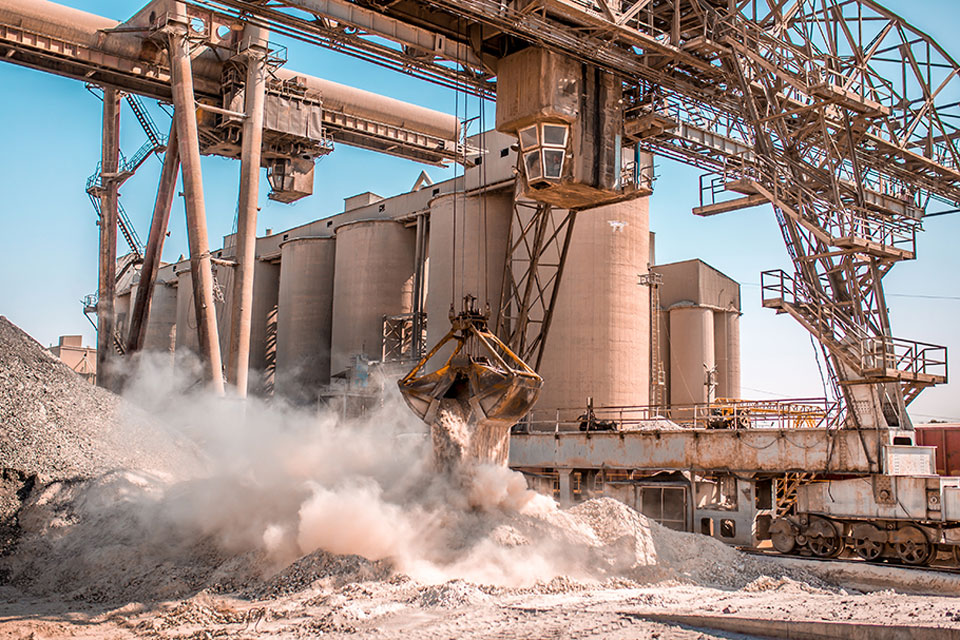
Cement production is a huge global industry. However, the basic production principles are simple: ground limestone is exposed to very high temperatures, close to 1,500 °C, whereby calcium carbonate reacts with silica minerals forming various calcium silicates.
Additives are then blended in to give the desired properties like curing time. Mixed with water, sand and gravel, the cement forms concrete which has almost unlimited usage areas within the construction industry.
ENVIRONMENTAL ASPECTS
The processing of raw materials generates very high levels of dust, and the fuel used for the heating as well as the raw material itself give rise to a variety of gaseous air pollutants, NOX and SO2, and sometimes also other pollutants like HCl and HF.
The very high temperatures required in the production process make the cement production plant attractive also for waste incineration purposes. Accordingly, it is not unusual to find cement kilns fired with all sorts of waste, some of which may be classified as hazardous. Although a lot of the emitted hazardous gases decomposes in the high temperatures, some may still slip through or react and form new hazardous substances, potentially resulting in emissions of for example dioxins and PCBs. In addition, both the basic reactions forming calcium silicates and the burning of the fuel give rise to high emissions of CO2.
EMISSIONS CONTROL
There is often legislation controlling the allowed emissions of air pollutants from cement plants, and with that comes requirements on continuous emissions monitoring (CEM) of the emitted pollutants.
For the kiln process in cement production, continuous monitoring of process parameters such as temperature, oxygen, pressure and flow rate, as well as of emissions of dust, NOX, SO2, and CO may be required. NH3 emissions (slip) must be monitored if an SNCR process is used to reduce the NOX emissions. There are also often requirements on continuous or periodic measurements of HCl, HF, and TOC emissions, as well as periodic monitoring of dioxins and metal emissions.
From an emissions perspective, the situation at a cement industry is often similar to that of a waste-to-energy plant, although often with higher dust levels in the flue gas. The cement industry is therefore a very well-suited application area for the OPSIS monitoring technology.
THE OPSIS MONITORING SYSTEMS
A major benefit of using continuously operating monitoring systems from OPSIS at cement production facilities is the DOAS open light-path monitoring principle, making the systems relatively insensitive to the high dust levels that often occur in the flue gas. Due to the dust, traditional extractive systems require a lot of maintenance and are prone to breakdowns. Another reason for using OPSIS monitoring systems is the need for the facilities to monitor the levels of a range of different types of gases, all of which can be conveniently measured using a single OPSIS monitoring system.
Numerous OPSIS gas monitoring systems have been successfully deployed at cement industries all around the world. Feel free to get in touch with OPSIS or either of its representatives to find out why the OPSIS monitoring systems are the best choice for process control and emissions monitoring at cement industries.