2026-11-17
Flue Gas Monitoring at Glass Manufacturing
Glass manufacturing is energy consuming, and the energy usually originates from fossil fuels. From an air pollution perspective, a glass manufacturing facility is therefore similar to a power plant. There are similar pollutants being generated and similar flue gas treatment processes are applied.
However, there are often also some notable differences, for example very high dust levels in the flue gases and high flue gas temperatures. The operating environment of monitoring equipment is therefore also often hot and dust laden. This calls for ruggedized monitoring equipment.
What is Glass?
Silica is the fundamental constituent of glass. Glass made of pure silica sand is referred to as quartz. It has very good optical and thermal properties but requires very high temperature for manufacturing. The melting point for the raw material is above 1,700 °C and its low viscosity makes it difficult to form.
Although quartz has its applications, standard glass is instead manufactured using various additives to the silica.
A common additive is sodium carbonate which acts as a flux and lowers the formation temperature to approximately 1,500 °C.
The soda makes the glass prone to chemical reactions. Lime, magnesium oxide and aluminium oxide are therefore also added to provide better chemical durability.
Glass Manufacturing
Glass production starts at the “batch house” where the ingredients are mixed and sometimes preheated. The exact proportions of the ingredients can be varied to finetune the properties of the glass.
The mix is fed into a furnace at a slow and precisely controlled rate. The furnace is normally gas- or oil-fired to allow precision control of the glass formation process at temperatures above 1,500 °C. The molten glass is then conveyed to the forming process under gradually decreasing temperatures.
Forming Glass
Glass used for windows and other flat surfaces is manufactured by gently pouring molten glass at about 1,000 °C onto one side of a shallow bath of floating tin. The glass is dispersed under the influence of gravity. It is transported along the bath and gradually cool down. At the end of the bath, a glass sheet can be lifted onto rollers for finalization.
In the process for production of container glass, a stream of molten glass at plastic temperature (1,050-1,200 °C) is cut to gobs. Each gob falls and is pushed into a mould. Compressed air is then utilized to give the container its shape.
In either case, the cooling during glass manufacturing can introduce stress which makes the glass prone to cracking. To prevent this, the glass undergoes a slow cooling process just below the solidification point of the glass. The process is called annealing and occurs in a temperature-controlled kiln dubbed a “lehr”.
Environmental Aspects
Glass industries do not come unnoticed from an environmental perspective. Raw material handling can give rise to particulate emissions, the heavy machineries cause noise, water used for cooling can be polluted, and the burning of fossil fuel cause emissions of air pollutants.
When it comes to the latter, there are often strict regulations on the emissions. To manage the emission limits, the industry typically applies a series of flue gas treatment processes:
filters are used to catch dust
scrubbers (“DeSOx”) help reduce both dust and SO2 emissions
NOX (NO and NO2) emissions are reduced through selective catalytic reaction (SCR) processes (“DeNOx”).
Where is Gas Monitored?
Gas concentration monitoring is applied both to control the treatment stages and to monitor the remaining emissions to ambient air.
When it comes to scrubbers, it is primarily a matter of measuring SO2 concentrations at the inlet of the scrubber. This allows control of the injection of the scrubbing agent, usually lime. SO2 monitoring at the scrubber outlet verifies the scrubber efficiency.
In the DeNOx process, ammonia (NH3) is injected and made to react with NOX. The NOX concentrations are measured at the DeNOx inlet to control the injection. At the outlet, NOX can be measured to verify SCR efficiency, and NH3 is often measured to check for any NH3 slip.
Typically, SO2, NOX, NH3, CO, O2, and H2O concentrations are measured in the tail gas, prior to being emitted to the ambient air.
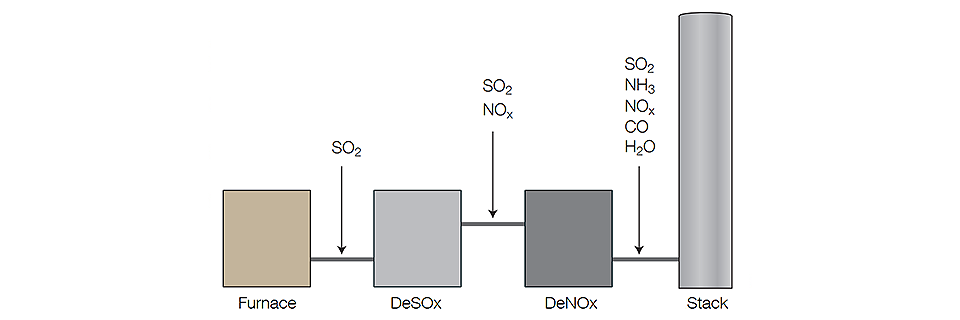
Typical flue gas treatment stages and monitoring locations at glass manufacturing.
Monitoring Challenges
Gas monitoring at glass manufacturing comes with some specific challenges. They may vary depending on the process and situation at the individual plant as well as the measurement locations, but the potential issues should not be neglected when preparing for an installation of a monitoring system.
It is not unusual to find that the gas itself is both very hot and dust-laden, far more than for instance at power plants.
Temperature and dust also mean that all parts of the monitoring equipment exposed to the general environment must be able to withstand this harsh environment. More delicate system components are placed in climate-controlled shelters.
Choosing the Right System
Far from all types of monitoring systems are suitable for operation at a glass manufacturer. They can require a lot of maintenance and be prone to breakdowns. However, there are also systems that have proven to operate very well under these conditions.
OPSIS is a supplier of monitoring equipment for both process control and emissions monitoring that have been successfully deployed at many glass manufacturing facilities around the world. The ruggedized design of the components located at the gas ducts and the use of fibre optic cables to allow more sensitive system components to be placed in protective shelters ensure trouble-free operation with a minimum of maintenance.
Feel free to contact OPSIS or either of its representatives to learn more about OPSIS monitoring equipment!
The original of this article has been written and reviewed by humans.
